12/14/2024
Company
Famitsu Interview on Founding of CLOVERS Inc.
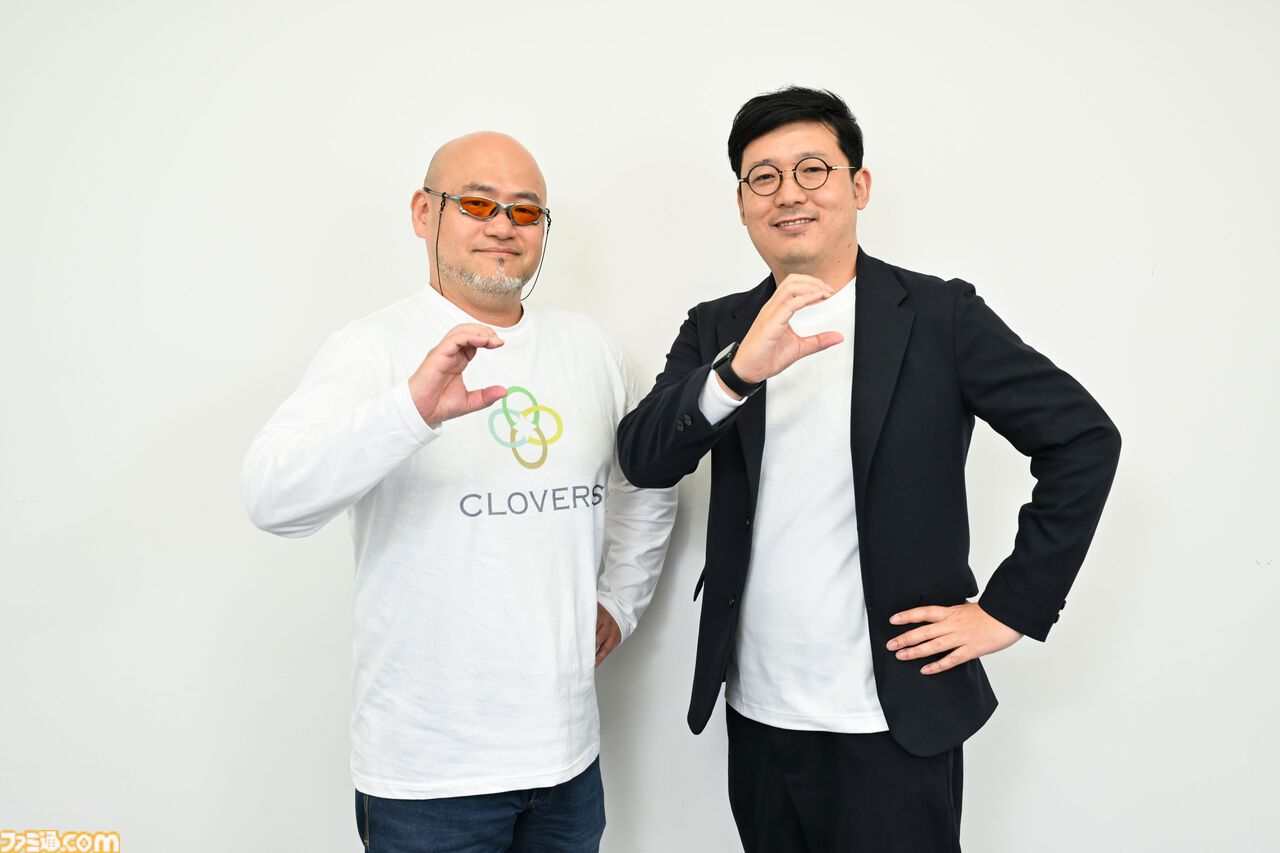
Famitsu.com has featured an interview with CLOVERS Inc. CEO Kento Koyama and Studio Head / Chief Game Designer Hideki Kamiya.
This post is an English translation of the original Japanese article posted by Famitsu.com [https://www.famitsu.com/article/202412/26485] on December 13, 2024.
Hideki Kamiya-directed “Okami Sequel” Project Kicks Off Launch of New Studio CLOVERS!
“We Put Artistic Integrity First”
“We Want to Build a Game Company that People Feel will Create Something Incredible”
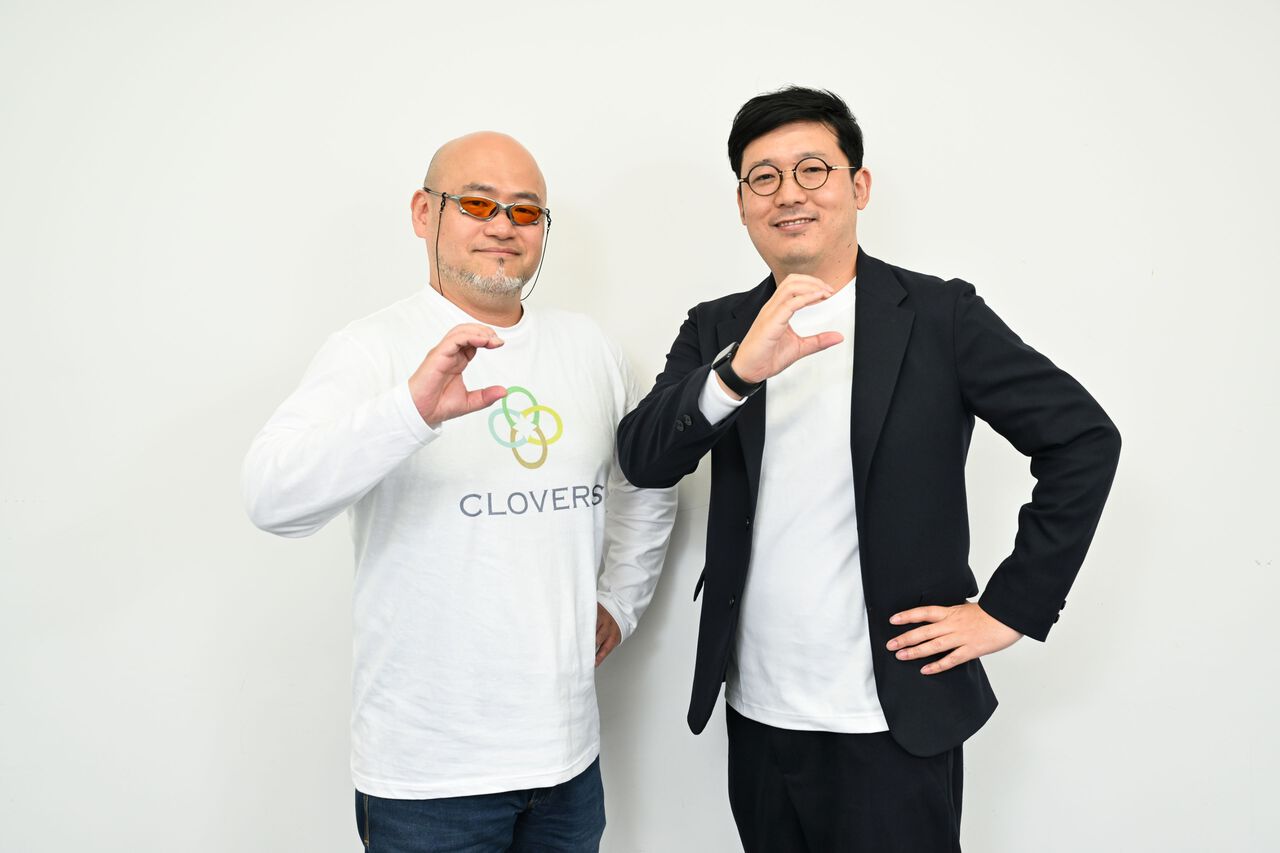
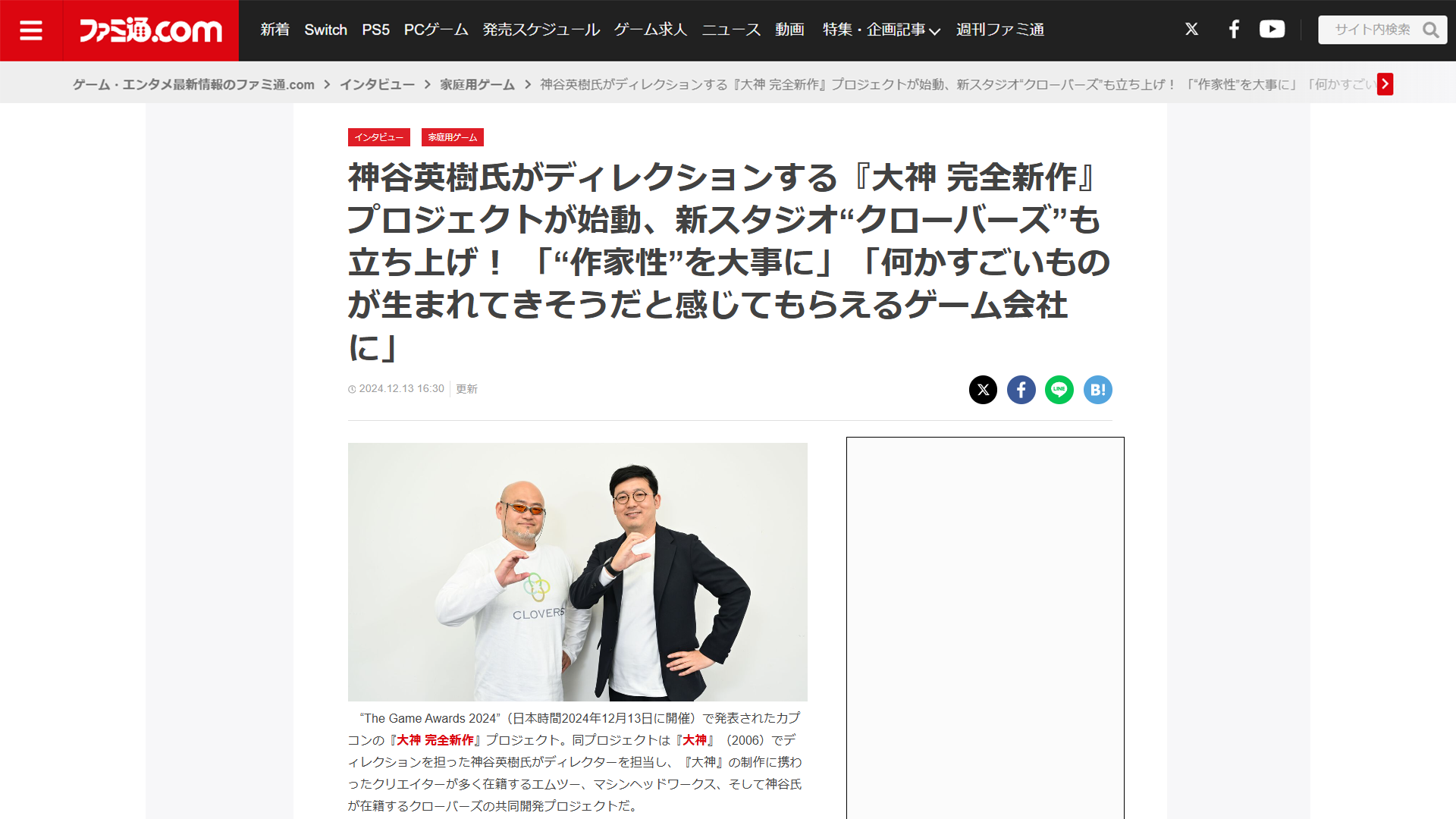
Capcom first unveiled the “Okami Sequel” project during The Game Awards 2024. The project is helmed by Hideki Kamiya, who directed the original “Okami” in 2006, and is being jointly developed by M2 Co., Ltd, which employs many creators involved in the original’s development, alongside Machine Head Works and Kamiya’s current studio, CLOVERS Inc.
For this article, we asked CLOVERS Studio Head/Chief Game Designer Hideki Kamiya and President & CEO Kento Koyama about their new studio. What kind of company is it, and what types of games do they aspire to create? How was the studio founded, what are its values, and what aspects of game design do they refuse to compromise on? Read on and find out.
Interviewer: Famitsu Group Representative Katsuhiko Hayashi
 Kento Koyama: President & CEO of CLOVERS Inc. After getting his start doing debugging work at Nintendo’s Mario Club, he joined DeNA to pursue his ambition of becoming a game designer, working predominantly on live service titles. He leveraged this experience when joining PlatinumGames, where he continued to work on live service titles before eventually going freelance. As a freelancer, he served as game designer on one of the games Kamiya was developing at PlatinumGames.
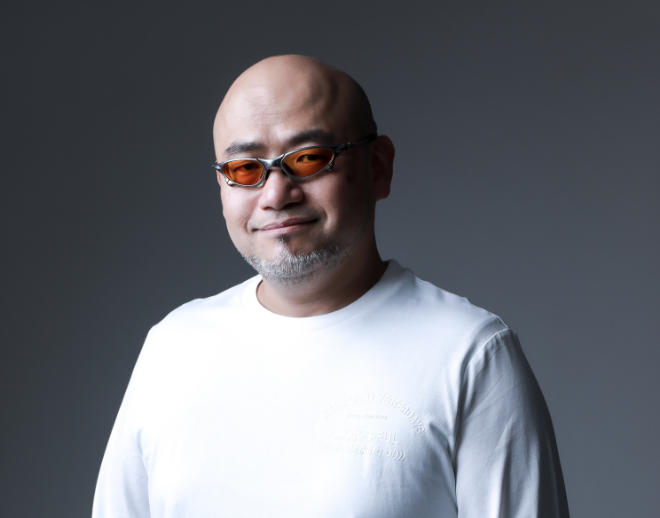 Hideki Kamiya: Born in 1970 in Matsumoto City, Nagano Prefecture, Japan. Known for his work as Director on “Resident Evil 2,” “Devil May Cry,” “Viewtiful Joe,” “Okami,” and “The Wonderful 101.” He was also Executive Director on “Bayonetta 2,” “Bayonetta 3,” “Bayonetta Origins: Cereza and the Lost Demon,” and “Sol Cresta,” providing overall supervision, creating the original concepts, penning the scripts, and more.
After working at Capcom, Clover Studio, and PlatinumGames, he joined CLOVERS Inc. as Studio Head/Chief Game Designer in October 2024. He is currently hard at work as Director on the in-development “Okami Sequel.”
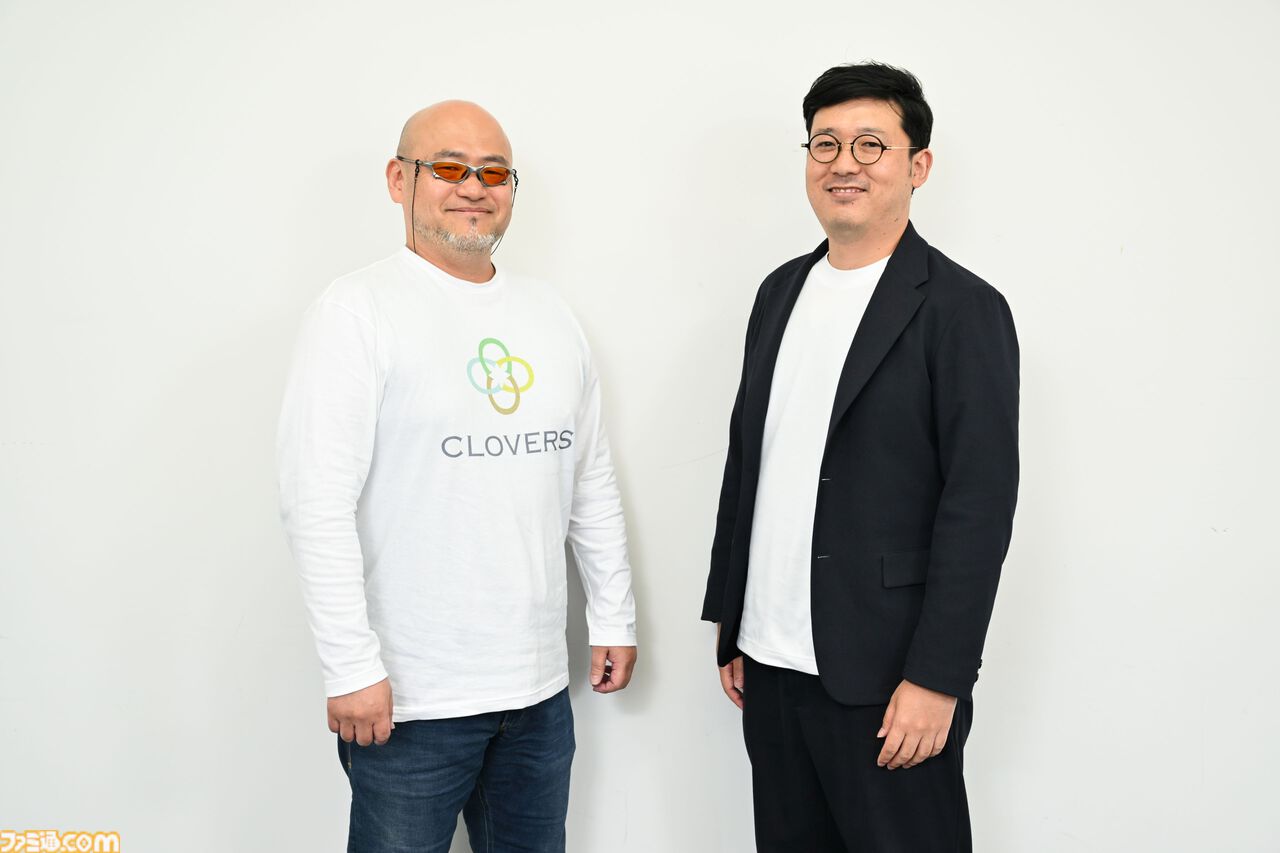
Koyama made up his mind as soon as he heard Kamiya was quitting. That was how it all began.
–I want to start things off by asking the two of you about your working relationship thus far, and how you ended up deciding to form this brand new game studio.
Koyama: Certainly. I worked together with Kamiya as a freelancer on the same project back at PlatinumGames.
Kamiya: Koyama and I were working on a certain project with myself as Director and him as lead game designer.
Koyama had actually been involved with another project at PlatinumGames prior to that, and I remember he had the type of highly organized, logical mind that was rare in a company that primarily developed action games. I decided I needed someone like that for the project I was spinning up. But by that point, he’d already left PlatinumGames, so I ended up reaching out to him directly and bringing him back on board as a freelancer to work with me on that project.
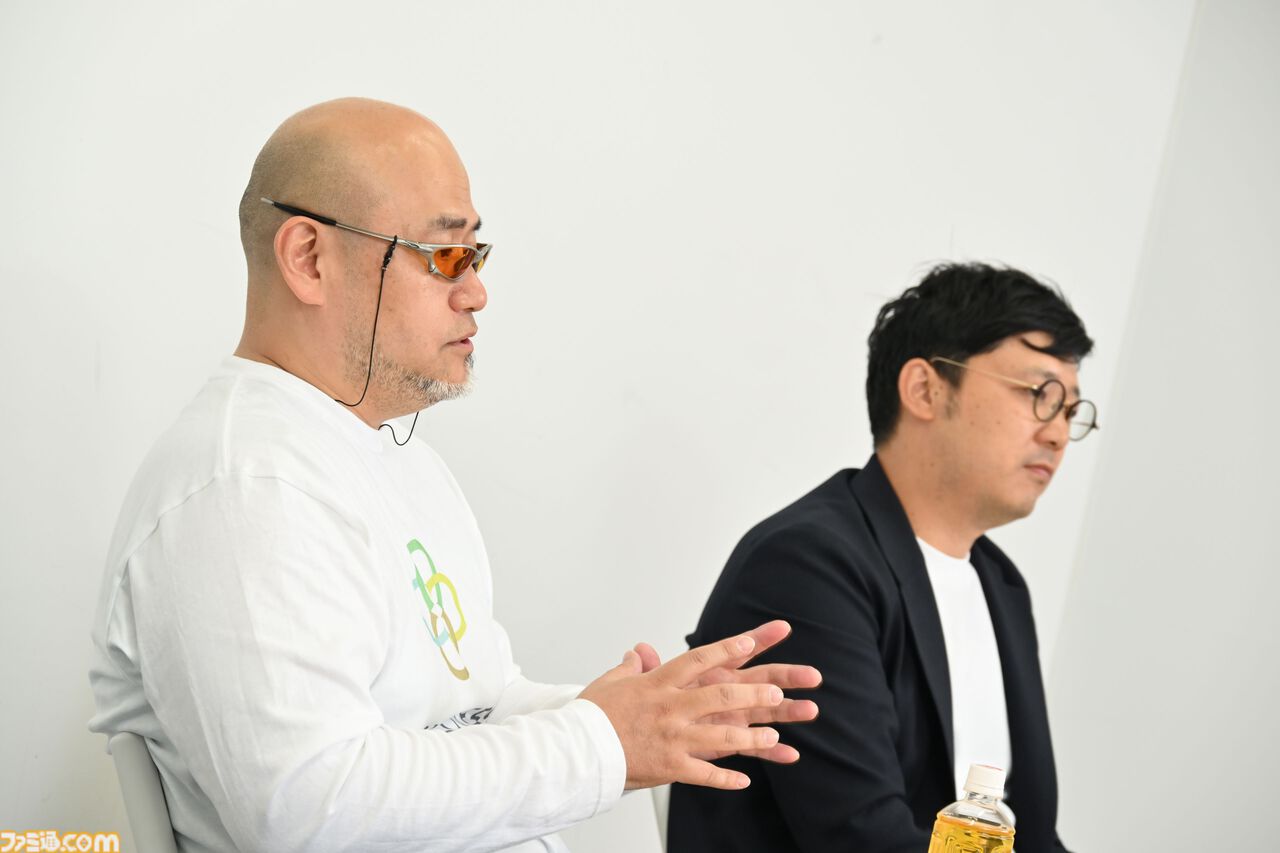
–I see. So when the two of you reunited, he was actually a freelancer.
Kamiya: I kept trying to hire him as a full-time employee, but he shot us down every time (laughs). [PlatinumGames CEO Atsushi] Inaba wanted to hire him too, and one day he actually pulled Koyama into a meeting room to make him an offer. I saw that and thought to myself, “Godspeed, Inaba,” but he walked out of the room not 30 seconds later and said Koyama had turned us down yet again (laughs).
–It’s clear both you and Inaba-san thought highly of Koyama-san’s abilities. And then, in October 2023, you announced your departure from PlatinumGames.
Kamiya: I officially left the company in October [of 2023], but I’d already decided to leave as far back as July of that same year. I knew I had to notify the staff who were working most closely with me, so I first pulled all my team leaders together to let them know I would be leaving the company and why. I let Koyama know right around that same time.
–What went through your mind when you heard that news, Koyama-san?
Koyama: The day I found out, Kamiya had this very somber air about him. He looked like he was in rough shape, physically, and his vibe was very different from the usual.
Kamiya: There was even a rumor going around at the time inside the company that I’d contracted some incurable illness (laughs). I’d gotten bronchitis in July and wouldn’t stop coughing during work, so a lot of people were pretty worried about me due to that, and it just happened to coincide with when I decided to quit. When I told people I had something important to tell them the following Monday, everyone was like, “Oh man, here it comes…”
Koyama: I thought to myself, “Wow, it must be a pretty serious illness…” (laughs). But, actually though, more than anything I was just shocked. Never in a million years did I imagine Kamiya would leave the company.
–Did you have any plan for what you’d do after you left, Kamiya-san?
Kamiya: Nope. I hadn’t given a single thought to what would happen after I quit.
When I told Koyama I was quitting, he asked me what I was going to do next. When I told him I’d probably start shopping around for a new job, he was the one who proposed going into business together if I didn’t have anything concrete lined up. The thing is, he asked me this right on the day I told everyone I was quitting, and it sounded so absurd that I didn’t seriously consider it at all in the moment.
–That was some real decisiveness on your part to propose something like that on the spot, Koyama-san.
Koyama: When I asked Kamiya why he was quitting, his reasons really resonated with me, so I never once thought he should reconsider or anything like that. But when he said he may need to leave the game industry altogether depending on how things panned out, I felt that would be a tremendous waste. I saw him as someone I could create some really amazing games with, so I broached the idea of just starting our own company.
–But it sounds like Kamiya-san wasn’t on board at that moment.
Kamiya: That’s right. As soon as I announced my departure, I started considering a lot of different options. I went drinking with Yoko [Taro, Director of the “NieR” series and other projects] and sounded him out about how being a freelancer worked, for example.
–And at what point did you start to seriously consider Koyama-san’s proposal?
Kamiya: Well, after I told the staff I would be departing, it’s not as if I left the company right away. I stuck around for another bit, and I told everyone that my door was open in case they wanted to speak to me about anything.
I was really taken aback by the outpouring of people who came by, with some of them asking me what led me to quit, or saying they wished they could keep working with me. That made me realize that if I were to go freelance, I would no longer have the opportunity to work with this circle of colleagues who said such nice things to me.
That being said, I’ve always been someone deeply entrenched in the front lines of game development, so I didn’t know the first thing about starting a company, and certainly didn’t have the disposition to run one. That’s when I remembered what Koyama had told me, and started to seriously consider his idea.
–And whenabouts was that?
Kamiya: It was probably within a week of me telling Koyama that I was quitting.
If it weren’t for Koyama, I’d possibly be working at a different company or freelancing right about now. Thinking back, if he hadn’t come on board when I invited him to join that other project, none of this would have come to fruition. It really does feel like fate at work.
–So the conversation moved quite quickly, then. Did you always think you’d want to start your own game studio someday, Koyama-san?
Kamiya: I remember you mentioning something like that.
Koyama: I was pretty much joking, though. I did have a desire to create a game together with my friends, but I’m just a game designer. Making an actual game requires artists, programmers, and so forth, and I had no interest in running a company.
–You had no previous executive experience prior to this, is that correct?
Koyama: That’s right. However, that is one area where my experience as a freelancer came into play. I’d done things like manage budgets at previous companies I’d worked for, so all of that accumulated experience was definitely there.
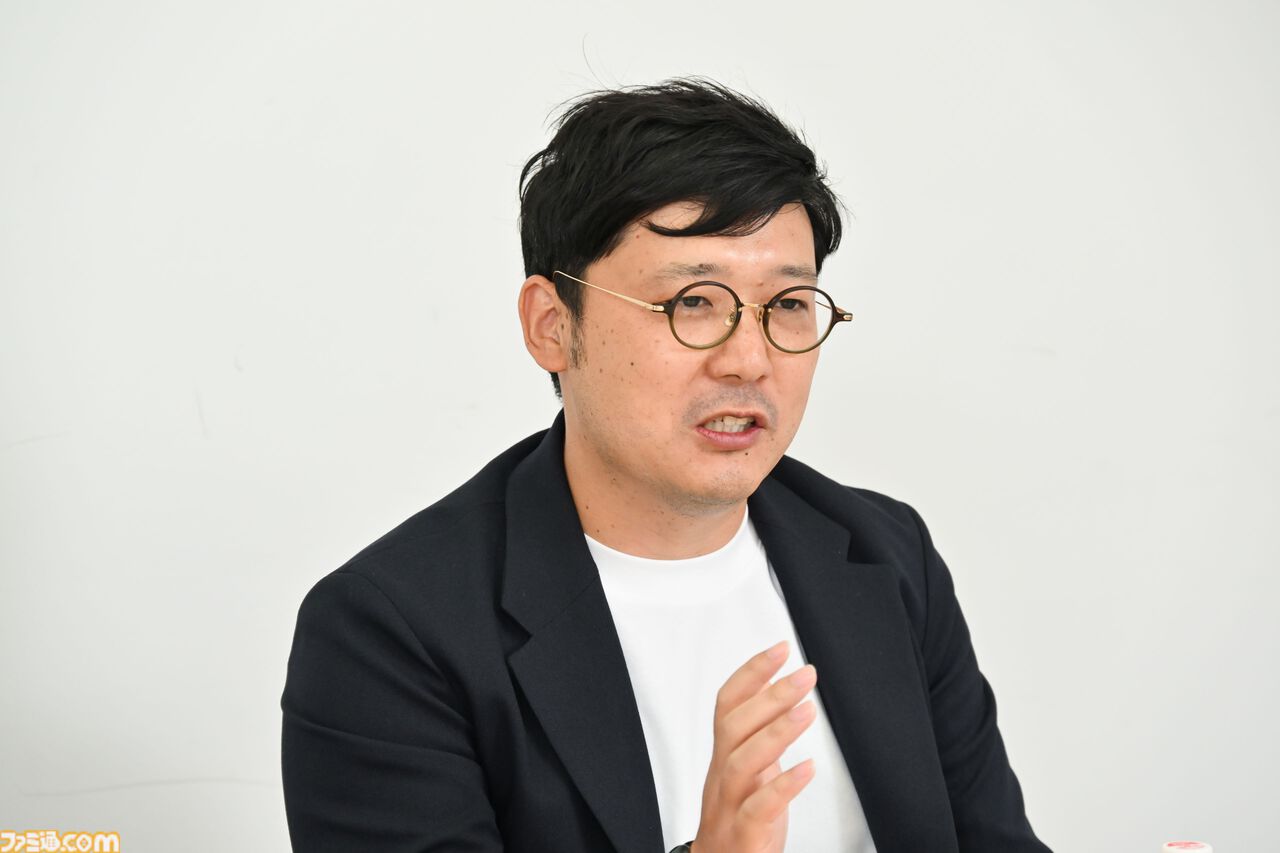
The reason for leaving PlatinumGames came down to differences over company trajectory. “That was something I simply couldn’t compromise on.”
–Taking one step back, what made you decide to leave PlatinumGames in the first place, Kamiya-san?
Kamiya: I’m unable to get into specifics, but I’m someone who lives and breathes game development. If I’m going to pour my heart and soul into the job, I have to be able to trust the company, otherwise I won’t be able to give it my all. I had a deep love for PlatinumGames, and as someone who was with the company from its founding, I was fully prepared to stay there until retirement. One entire wall of the company was filled with my action figures and plastic models. I’d made myself at home, in other words (laughs wryly). I used to joke about what would happen to all those personal belongings if I ever left the company, but little did I know that the day would actually come. That was how unthinkable the idea of ever quitting was to me.
–Yes, your love of PlatinumGames was well-documented, which is why it came as such a shock to myself and the rest of the gamer community.
Kamiya: I’ve never approached game development as a means of self-expression. For me, it’s always been about being an entertainer who creates experiences users will enjoy, and thereby making PlatinumGames’ name shine all the brighter. That’s why I was fully committed to giving it my all, but it got to a point where I could no longer trust the company the same way, and I had to make the decision to move on.
–How did Inaba-san react? (PlatinumGames CEO Atsushi Inaba, whose long collaboration with Kamiya goes back to their days at Capcom)
Kamiya: I’d been in continuous dialogue with Inaba, but there were just certain areas where we just couldn’t see eye-to-eye. Right up until the last, each of us tried to insist on our own perspectives, and at a certain point, the differences became irreconcilable.
I made a point of never threatening to quit during our discussions, because I didn’t want to use that as leverage to force Inaba to take back what he was saying. I avoided saying those words until I had well and truly made up my mind, and Inaba understood that as well, which is why when I told him I was leaving, he accepted my decision with no further argument.
–So rather than someone being right and someone being wrong, it was more of a discrepancy between the direction the company was going and what you wanted to do.
Kamiya: That’s right. When we left Clover Studio (A subsidiary of Capcom branched off from one of its internal game development departments. Hideki Kamiya was one of its founding members. Dissolved in 2007, the studio developed titles such as “Viewtiful Joe” and “Okami.”) and founded PlatinumGames, we were still a small team of around 50 people, but that’s since grown to six or seven times that number. Along with outside investment from Tencent, the structure of the company has changed considerably since those early days.
I did hold positions such as Director [on the Board of Directors] and Vice President, but since my primary focus was always on the front lines, I wasn’t really involved with the running of the company. I firmly believe managers and creatives each have their own ways of thinking, and this was a result of those not aligning. This touched on the essence of my career as a creator, and that was something I simply could not compromise on. It’s not that I had any kind of falling-out with Inaba, Yamane (Takao Yamane. Executive Vice President/Chief Business Officer at PlatinumGames), or the rest of upper management.
However, while it may sound presumptuous to say, I did take pride in being one of the people carrying PlatinumGames on his shoulders. So, when I decided to leave, I did feel a sense of guilt at betraying the rank-and-file staff in that regard. I still feel sorry about that aspect to this day.
–Did you ever ask Mikami-san for advice regarding your decision to leave? (Shinji Mikami. Director and Producer of various titles such as “Resident Evil” during his tenure at Capcom, and Kamiya’s former boss and mentor figure)
Kamiya: I didn’t ask him for advice, but I did let him know. Only at first, I didn’t want to bother him with something like that, so I couldn’t quite bring myself to reach out. He ended up hearing about it from somewhere else, and all I could do was apologize for being too hesitant to tell him. Still, he responded with some very kind words. I feel really bad for constantly making trouble for him.
–This is a slight tangent, but do you have any desire to make something together with Mikami-san again?
Kamiya: That’s not going to happen (laughs). Mikami-san is another one who always said, even all the way back in our [Capcom] Production Studio 4 days, that he didn’t want to do management. He just wanted to be making games directly.
–So he’s the same type of creator as you, then (laughs).
Kamiya: Mikami-san’s passion for creative work is unreal. There’s no way the two of us would ever get along (laughs).
–Both of you have your visions and neither is willing to deviate (laughs).
Kamiya: I often hear users speculating about how great it would be if such-and-such creators teamed up on a game, but I just can’t see it working out. It wouldn’t be like they’d fuse together and power up. It’d be more likely to end up as if they were attached at the hip and trying to run a three-legged race in opposite directions (laughing).
The origin of the name “CLOVERS” and the meaning behind it
–Next, I want to ask you about the newly established CLOVERS. Could you start by telling us about the origin of the company name and the meaning behind it?
Koyama: We had a lot of different ideas for the name, but none of them quite clicked. That’s when Kamiya had the idea to call it CLOVERS.
Kamiya: Looking at the word, your mind automatically goes to a four-leaf clover, but you can also break it apart and read it as “C Lovers.” That “C” can stand for a lot of different things that we want to value as a company, such as “Challenge,” “Creativity,” or “Courage”
–I see.
Koyama: We mapped those to a four-leaf clover, and internally we always say that we value our “Four C’s.” Those are “Challenge – always keep challenging ourselves;” “Creativity – never stop creating things;” “Craftsmanship – pride ourselves on excellence.” And then each employee chooses a fourth “C” to represent themselves.
Kamiya: It was Koyama’s idea to have everyone choose their fourth “C” themselves. We weren’t able to decide on an official fourth one, and he had the idea to just let everyone pick their own. Everyone having their own value that they want to uphold also aligns with the type of employees we’re looking for. The company has its shared values, but we also want to treasure everyone’s individuality.

The company logo is meant to resemble a four-leaf clover. Each “leaf” is made up of the letter “C,” which combine into the shape of a clover.
–Oh, so everyone has their own C’s. And what are yours, if I may ask?
Koyama: Mine is “cleanness,” as I always want to operate in good faith towards both business partners and our employees.
Kamiya: Mine is “curiosity,” because I believe that’s what lies at the heart of creativity for me.
Koyama: Other employees have ones like “confidence,” and also some funnier ones like “coffee break” (laughs). The idea behind that one being that creativity requires some mental breathing room.
–Breathing room is certainly important (laughs). Hearing “CLOVERS” automatically brings Clover Studio to mind, but it sounds like that’s not where you got the name from.
Kamiya: Well, Clover Studio was certainly one source of inspiration.
With Kamiya officially onboarded at CLOVERS, the wheels are fully in motion
–And I suppose I should ask for the record: Am I correct to assume that CLOVERS is a game development company?
Koyama: That’s right. We design and develop video games.
Kamiya: On the topic of the letter “C,” our goal is to form the “core” of the games we develop. We don’t intend to grow the company into this massive organization; instead, we want to maintain a structure where everyone is closely connected, from top to bottom. And whether working on a huge project or a small one, we want to be in control of the most important aspects. That’s how we want to approach game development.
–Many independent developers tend to have a strong desire to create original IP that they can fully own. How do you envision CLOVERS’ relationship to IP?
Koyama: Just speaking for myself, my honest opinion is that I don’t see the owning of IP as an end unto itself. Of course, being able to own an IP is nice, and I do want to release some titles where that’s the case, but it doesn’t feel right to make IP ownership the main goal. Essentially, it’s fine if we end up owning an IP as a result, but doing something just for the sake of owning an IP feels like the wrong approach.
Kamiya: My own take is pretty close to that. I don’t think owning an IP is an absolute must. But rather than being asked to build on something that already exists, what I would like to make one of our strengths is the ability to create a game from scratch, including being able to propose the characters, game mechanics, setting, and flavor of game.
So I’m fine to nurture an IP over time alongside a publisher, and if users respond well and the time comes to create a sequel or expand on it in some other way, my hope is that we would remain at the core of creating whatever that is.
–I see. And how many employees does CLOVERS have, currently?
Koyama: A little under 20 people.
–That’s already quite a few, then.
Koyama: We sort of gathered people gradually during the preparation stages. The company was actually founded a year ago, but it’s only now that Kamiya officially joined us on October 13 of this year that the wheels are fully in motion.
–You must be feeling very excited, Kamiya-san.
Kamiya: I sure am, since I’m finally back at work and able to get on with making video games again. Right after PlatinumGames was founded, we were in this bare-bones office that had nothing but desks and computers. We had no libraries to work from, the programmers were still putting the dev environment together, and the designers had to make do with looking over reference materials, so I just had to do whatever I could with pen and paper. This feels pretty close to that era, but with an even stronger sense that we’re doing everything by hand, so it’s a lot of fun.
–What size do you ultimately want to reach in terms of headcount?
Koyama: In our initial conversations, we wanted to keep it to around 40 people. However, taking the realities of modern game development into account, controlling the core design of a game would still require a pretty decent number of people, so we likely need in the ballpark of 60 to 70. Later down the line, when we have the bandwidth for multiple projects, we might grow to as many as 100. For now, we’re shooting for between 60 and 70.
–Are there any ex-PlatinumGames staff among your current employees?
Kamiya: Yes. Some of those who came to speak to me after I announced my departure have come over. Of course, we didn’t poach them or anything, though.
Koyama: Kamiya and I agreed from the start that we wouldn’t do things like that.
Kamiya: Especially since we value “cleanness” and operating in good faith.
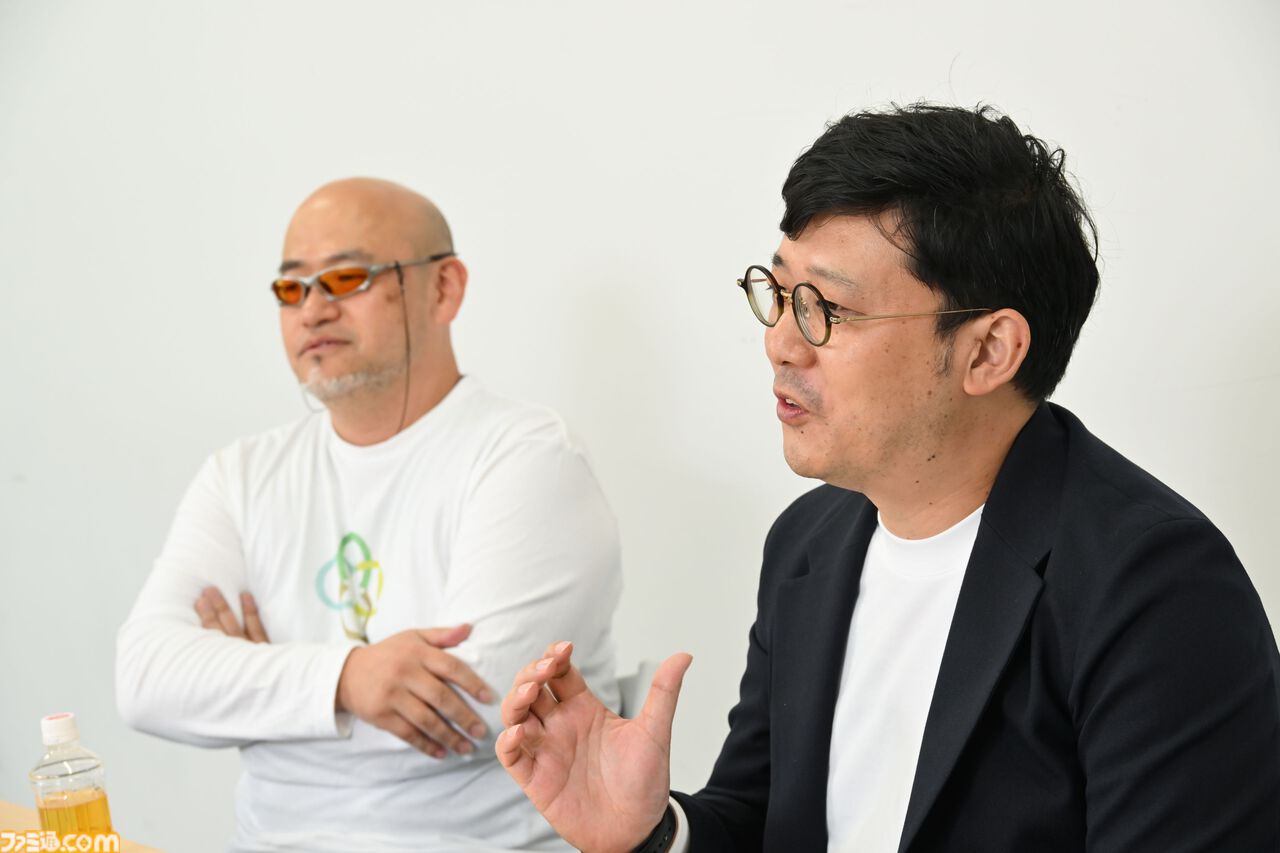
Kamiya as Studio Head/Chief Game Designer. As Director, he is also deeply involved with game development.
–Once again, for the record: I take it you intend to continue creating games as a director at CLOVERS, Kamiya-san?
Kamiya: Yes. I’ll leave the running of the company to Koyama and his highly organized, logical mind (laughs). But I also want Koyama to be involved with the actual game development as well. He’s a formidable game designer in his own right, and I know he harbors ambitions of directing a game someday.
Koyama: Agreed. I’m not sure how much involvement I’ll be able to have alongside my CEO duties, but it’s something we’re thinking about.
–And what’s your exact positioning within CLOVERS’ structure, Kamiya-san?
Kamiya: In terms of job title, I’m the Studio Head/Chief Game Designer. I just like the ring of “Studio Head,” so it’s something I always wanted to call myself. The more important part is definitely “Chief Game Designer,” which was my title at PlatinumGames as well.
–Would you say you have a special attachment to the title of “Game Designer,” then?
Kamiya: Considering it was my dream job when I was a kid, I definitely want to keep “Game Designer” in my job title.
–And does the “Chief” part imply some type of advisory role towards the other game designers?
Kamiya: I would say so. While continuing to work as a director, I do eventually want to spin up multiple dev pipelines, which I would entrust to those with the desire and creative vision to handle director duties. I’d like to advise them on that and hopefully help prevent a lot of the unnecessary pitfalls I tripped on along the way. I would be able to help them accelerate towards whatever direction they’re trying to go and help any games that CLOVERS launches are truly outstanding.
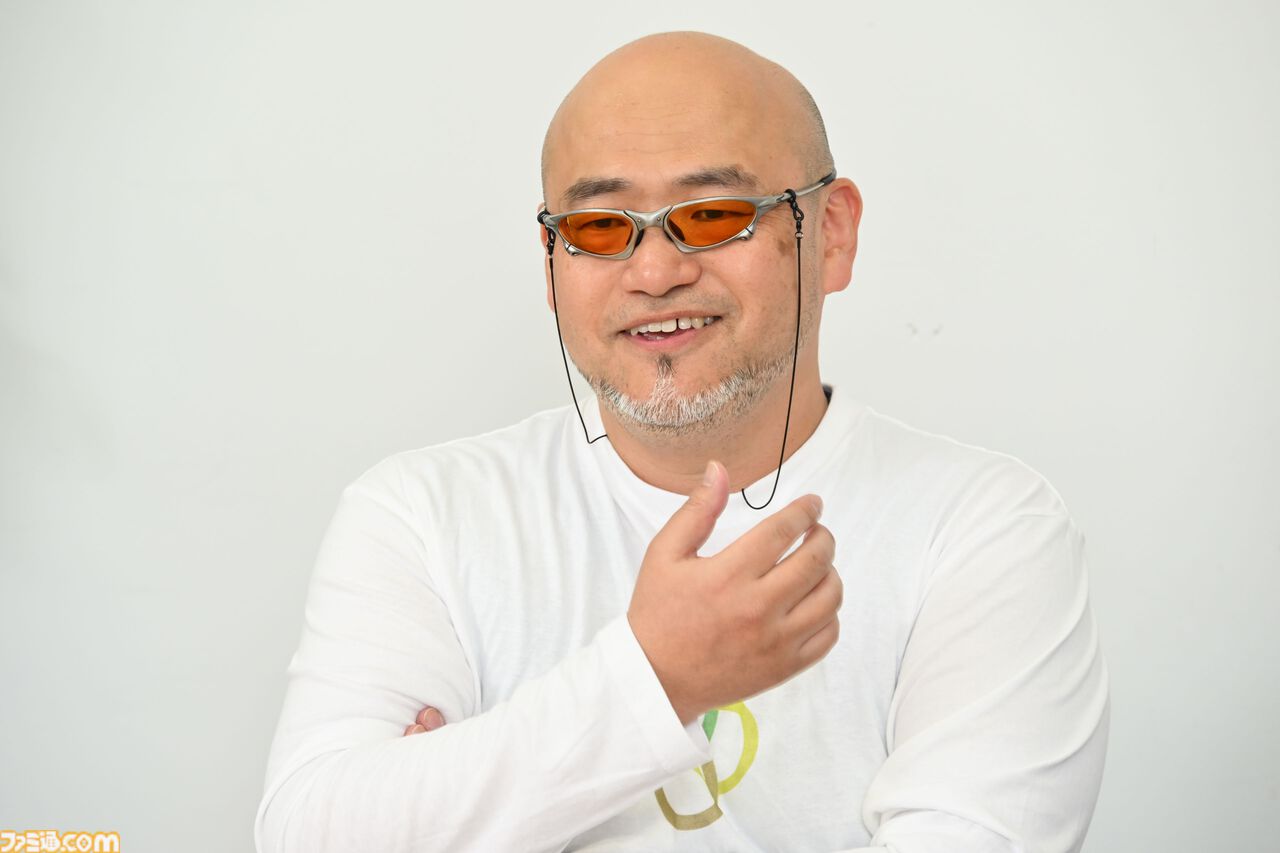
We’re not too particular about the platform, but our current strengths are definitely more in the console space
–You spoke earlier about the importance of the letter “C.” Does one of the C’s potentially stand for “Console” as well? Or are you setting your sights beyond solely console games to explore mobile and other platforms?
Koyama: As long as we can create great games, I don’t think we need to be too particular about the platform. With that said, our current strengths are definitely more in the console space at the moment.
I myself do have experience as a designer on live service titles, and some of my contacts from that era have since joined our company. So I don’t think we would be unequipped to tackle a mobile game if it came to that, but it’s just one option among many.
Kamiya: With the caveat that nothing is off the table if we think it would lead to something interesting, we want to start out by playing to our historical strengths and going with what we’re good at.
–How are you handling funding? For example, do you have any sponsors or investors?
Koyama: We don’t accept outside investment. We operate entirely using our own capital to maintain the company’s independence. That said, we are open to receiving development funding on a project-by-project basis.
What kind of games does CLOVERS aim to create?
–As more staff join CLOVERS over time, can I ask what kind of games you’ll be looking to create?
Kamiya: We will continue to prioritize artistic integrity and make it a central focus. We want to be a studio where that style of creativity thrives, and we want to release games that embody that spirit. This is something I feel very strongly about.
One of the major industry trends I see these days is a move away from making games that depend on specific individuals.
–What do you mean by that?
Kamiya: For example, there are many AAA titles being released, but recently it’s very rare that you’re able to attach a specific creator’s face to any given game. There are still some exceptions such as director [Hideo] Kojima or Yoko [Taro]-san’s games, which are shaped by their own distinct styles, and that becomes part of the product’s identity and value. But that’s just a tiny fraction of the overall industry.
–It does certainly feel like the creators don’t get to be as prominent as they used to be.
Kamiya: If we’re going to wear our hearts on our sleeves and make games, then I think we need to really value the artistic integrity we carry at our core.
Something I’ve told my teams over and over is that I don’t want them to approach their jobs solely with the aim of obtaining my approval. So if I ask someone to draw me a character with a red coat, I don’t want them to just say, “Here it is, fully red like you asked.” I want them to think it through for themselves, and maybe they come back and tell me, “Actually, I think an accent color would make it stand out more.” Or in an extreme case, maybe they decide that a blue coat would look better. I’d be fine with that.
–Because thinking for yourself ultimately leads to more unique work and better creative expression.
Kamiya: I like people who put their pride on the line and go above and beyond what I’ve asked them to do, rather than just trying to get the OK from me. I believe the team we’ve assembled all excel at this and this is something we’ll continue to value when making games moving forward. This is something that Mikami-san instilled in me back at Capcom Production Studio 4, and actually, on a very personal level, the “four” in our four-leaf clover signifies Production Studio 4 in my mind. Because I’m proud to have worked there. Although, if I say that too often, people will start thinking I’m treating the company like my own personal property (laughs).
I want to work with the kind of people who are so talented they make you say, “Without this person, the game wouldn’t have turned out nearly as well.”
–Where is CLOVERS’ office currently located?
Koyama: We have one in Osaka and one in Tokyo. They’re both small rental spaces for the moment, but going forward we want to set ourselves up in some suitably large accommodations.
Kamiya: Our Tokyo location is pretty much at max capacity already, right?
Koyama: Osaka is full as well. Space is so tight we had to clear the snacks off the snack table so people could put their computers there (laughing). We’re planning to move to some slightly larger premises as soon as this coming January for Osaka and March for Tokyo.
Kamiya: We’ve already inspected the sites and the next steps will be to decide on the interior design and move forward with construction.
–I suspect you’ll have lots of folks wanting to make games with you after reading this article.
Kamiya: I’m more nervous we’ll scare them off, if anything (laughs).
–I highly doubt that’ll be the case (laughs). While we’re on the topic, why don’t you tell us what type of people you’re looking to recruit?
Kamiya: The most important thing is mindset. This is something Koyama and I often discuss, but we want people who take pride in their work, as I just mentioned. That’s the big thing. The kind of people who will take the initiative instead of sitting around and waiting. That shouldn’t be something you have to force yourself to do; I believe a true creator is driven by a creative impulse to do things simply because they want to. I’ve seen people work miracles on past projects time and time again simply because they made a thing even though nobody told them to. I want to work with the kind of people who are so talented they make you say, “Without this person, the game wouldn’t have turned out nearly as well.”
–Are there any specific disciplines you’re shortstaffed on at the moment?
Kamiya: Pretty much all of them, honestly. Even with our current 20 employees and counting, we’re still very far from the 60 to 70 number we mentioned.
Making a large game in this day and age requires 100 people or more, so I already know we won’t be able to cover that with just inhouse staff. That’s precisely why we want to surround ourselves with intensely capable, impactful people who will form the core of our projects. People who can take on a leadership role within their discipline, even when working with outsource partners, and drive their group forward with a strong vision. Those are the types of people I want to work with.
–After joining, are employees able to choose whether they want to work out of Tokyo, Osaka, or even remotely?
Koyama: That’s something we’d decide based on their personal and home-life circumstances. Depending on the situation, even remote work would not be off the table.
Kamiya: I like to think we’re a fairly flexible company when it comes to that kind of thing.
Could this be fate?! A miracle during the company’s founding
–Kamiya-san, you joined Capcom back in 1994, which means you’ve been in the game industry for 30 years now. Do you feel like there’s something meaningful about you getting this fresh start at such a milestone?
Kamiya: Well, if we’re talking about meaningful occurrences, just as I started talking to Koyama about the future and we’d recruited a few employees, we decided we should start looking into finding an actual office, even if it was just temporary.
Koyama came back one day saying he’d settled on a location, and we went to check it out. Turns out, it was right near the building I used to work at during my younger days at Capcom, so as we were walking up I started reminiscing about how “oh, there used to be this great restaurant here!” and things like that.
–Back in familiar territory, then.
Kamiya: We eventually arrived in front of the building where Capcom’s development division used to be located, and I said, “Yeah, here it is. This is the building I worked out of right after I joined Capcom.” To which Koyama replied, “Oh, well, the office I rented is actually in this building.”
–You’re kidding! (laughing)
Koyama: It was by complete coincidence.
–It’s crazy that coincidences like that actually happen (laughs). You actually didn’t know, Koyama-san?
Koyama: Seriously, I had no idea. When I’d sent Kamiya the location previously, he didn’t react at all (laughs). I saw more than ten different properties, and that one was the best fit in terms of both budget and location.
Kamiya: In my defense, the building has a different name now, and I didn’t give the map Koyama sent me a serious look because I’m pretty familiar with that entire area (laughing). But who would have thought it? And what’s more, the office space we’re renting is on the same floor the game developers worked in back in the day.
–That’s incredible.
Kamiya: The interior’s been renovated and looks really nice now, but the elevator and stairs still have traces left over from before. Crazy to think that when I push the button for floor 4, it’s the same button I used to push 30 years ago.
Koyama: Not only that, the space we’re renting is the exact place Mikami-san used to sit, right?
Kamiya: That’s right!
–This has now gone beyond incredible and straight into eerie (laughs).
Kamiya: It used to be a single open floor plan, which has now been divided into smaller sections and turned into rental offices, but our space all the way in the back happens to be exactly where Mikami-san’s seat used to be. The old steam heater is even still sitting in one corner. Obviously, it doesn’t work anymore, but it’s interesting that there’s at least one object that was also there 30 years ago.
It brought back all sorts of memories. “There’s the spot where we used to stack up all the exposed ROM chips.” “Oh, that’s where Mikami-san used to scold me as I stood with my back to the steam heater.” It was like I’d travelled back in time. I couldn’t believe we were starting again from scratch in the exact place I got my own start back in 1994.
–Back to your roots, in more ways than one. It almost sounds too good to be true (laughs).
Kamiya: It’s amazing, right? But the space is packed to the brim now, so we’re looking to move to a new office. I’m already feeling a bit melancholy about moving out (laughs).
What comes next for Kamiya’s YouTuber (?) career
–Shifting gears somewhat, during that one-year gap between leaving PlatinumGames and joining CLOVERS, your YouTube channel was getting a lot of buzz.
Kamiya: I may have been unemployed, but I was hard at work as a YouTuber. I’ll have you know I had a cool 30,000 yen (approx. $200) deposited straight to my bank account over the past year (laughs).
Koyama: His channel is monetized (laughs).
Kamiya: I still haven’t made back the equipment costs. The microphone cost a pretty penny.
–And who handled the video editing?
Kamiya: That was me. Although I’ve been too embarrassed to admit it.
–Embarrassed?
Kamiya: After trying my hand at YouTube, I’ve gotten a new appreciation for how talented the YouTubers out there are. Not just their ability to come up with interesting concepts, but the courage to actually go through with it and especially their editing skills to put everything together.
As someone who watches videos every day and hates when they’re overly long, I try to trim out the filler and keep the pace snappy. But as an entertainer, I still want to make people happy with the videos I edit, so I think a lot about the presentation too. For example, let’s say I add sound effects to a cringey scene. Then it feels like I’m telling people, “This is the funny part,” and that makes me feel really embarrassed (laughs).
–It feels like it’s super on the nose, right? (laughs)
Kamiya: When I add a sound effect to make it clear that I’m just fooling around, it’s kind of like, “What am I even doing here?” (laughs). I thought about passing it off as if someone else is doing the editing, but I’ll just come clean. I do it all myself.
–But someone else does the filming, right? May I ask who?
Kamiya: I ask one of my friends who used to work at PlatinumGames to handle that. I’m not exactly proud of it, but I wasn’t paying them for it, or anything. They were just rolling the camera for me as a favor to a friend.
–I can imagine you must have had a bit more time on your hands after departing PlatinumGames, but what made you choose YouTubing?
Kamiya: You know how all those international films always have the scene where the person quits their job and you see them walking out of the building with all their belongings in a cardboard box? I wanted to do one of those (laughs).
When I was packing up all my toys into boxes as I prepared to leave, I set aside the ones that would look best on camera and actually bought the box I used from Amazon Japan (laughs).
–So the video was a total sham (laughs)
Kamiya: And this goes for X as well, but essentially I just wanted to interact with the users. Having said that, I then proceeded to block a ton of them on X (laughs).
–Truly a masterclass in the art of blocking.
Kamiya: The way I think about X is that it’s like a massive bar counter, and I’m sitting there chewing the fat by myself. If some loser comes up to me, I send them away by blocking them. That’s the idea.
That’s why I started YouTubing. I figured there must be users who would be curious what I would be up to after leaving PlatinumGames. YouTube was my platform for broadcasting that.
–And has the user reaction been different than on X?
Kamiya: Pretty different, yeah. I’ve had a lot of people basically say “I always thought you were some dangerous loose cannon based on your X profile, but turns out you have a heart after all, Kamiya-san” (laughs). A lot of people outside of Japan especially have told me that. Things like, “I didn’t have you pegged for someone who spoke with a smile on his face!” (laughs).
–I imagine you won’t have as much time to spare now that you’ll be back in the game dev trenches, so what’ll happen with your YouTube?
Kamiya: I definitely won’t have time to do my own video editing anymore, but since I happen to have the channel, I imagine we’ll use it as a platform to put content out there that only we could have made, that’s completely separate to anything we do for clients. I’m sure we’ll have an official CLOVERS channel eventually, but for now, it’s just my own personal channel.
The longer it went on, I started getting all kinds of people writing comments and I answered a lot of user questions. It was really fun. I’d definitely love to keep going with it.
The future of CLOVERS
–You’re currently 53 years old, Kamiya-san. Have you thought about where you see yourself and CLOVERS in five or ten years’ time?
Kamiya: Not even a little bit (laughs).
Koyama: That’s probably one area where I see things differently from Kamiya. Now that I’m running an actual company, and we’ve brought together so many talented young and talented creators, naturally one of the things I want is for us to reach a point where we’re no longer “Kamiya’s studio.” I want us to be a company that can keep developing games for many decades to come.
Kamiya: I definitely agree with that. Even back at PlatinumGames, I had the pleasure of seeing many up-and-coming directors stepping up to the plate. People like [Takahisa] Taura on “Astral Chain” (also a game designer on “NieR: Automata), [Yusuke] Miyata on “Bayonetta 3,” and [Abebe] Tinari on “Bayonetta Origins: Cereza and the Lost Demon.” It was fun for me to watch them create games based on their own artistic sensibilities, and it was very reassuring as well.
It’d be great if we could see people like that emerging at CLOVERS as well; people who will carry the future on their shoulders, or at least let me sit back and rest easy (laughs).
–It would be great to foster the type of environment that breeds many talented new directors, and then you can keep making the things you love.
Kamiya: Definitely. I’m the type to get irrepressibly jealous of anyone who makes something incredible regardless of their age. Like, “Pfft, look at this jerk showing off” (laughs). So even if someone young and talented starts to shine, that’ll just stoke my competitive spirit and push me to keep on creating. That’s all I know how to do.
–I’m so happy to hear you say that. And lastly, could you leave us with a message from the two of you to everyone out there who is expecting to see great things from CLOVERS?
Kamiya: I always struggle with this part.
Koyama: This is actually my first time doing one of these kinds of interviews. I’m totally drawing a blank here on pithy messages to close things out (laughs).
Kamiya: (Looking at Koyama) I’ve done a million interviews, but the final message is always the hardest part (laughs). It always just boils down to “We’ll do our best.”
Koyama: We really will do our best, and I hope everyone out there will look forward to what we create. Kamiya spoke about artistic integrity earlier, and that’s something I really value as well. I also hope we reach a point where people trust that any game our studio creates will turn out awesome. Of course, we want our games to be hits too, but more than that, we want to be a company that people just know is going to create something incredible.
Our current group of staff have this “spirit of hospitality” that allows them to cover for each other beyond the boundaries of their exact job roles and fill in wherever there are gaps. I don’t want that to change even as the company grows larger, and I hope we can create great things that video game fans will love.
Kamiya: For now, we’re just going to give it our all on the project we’re already committed to. That said, as Koyama just mentioned, we’ll do our best to show the world exactly what kind of company we are by delivering something so surprising and awesome that people will think, “Wow, is there anything these guys CAN’T do?”
This post is an English translation of the original Japanese article posted by Famitsu.com [https://www.famitsu.com/article/202412/26485] on December 13, 2024.